

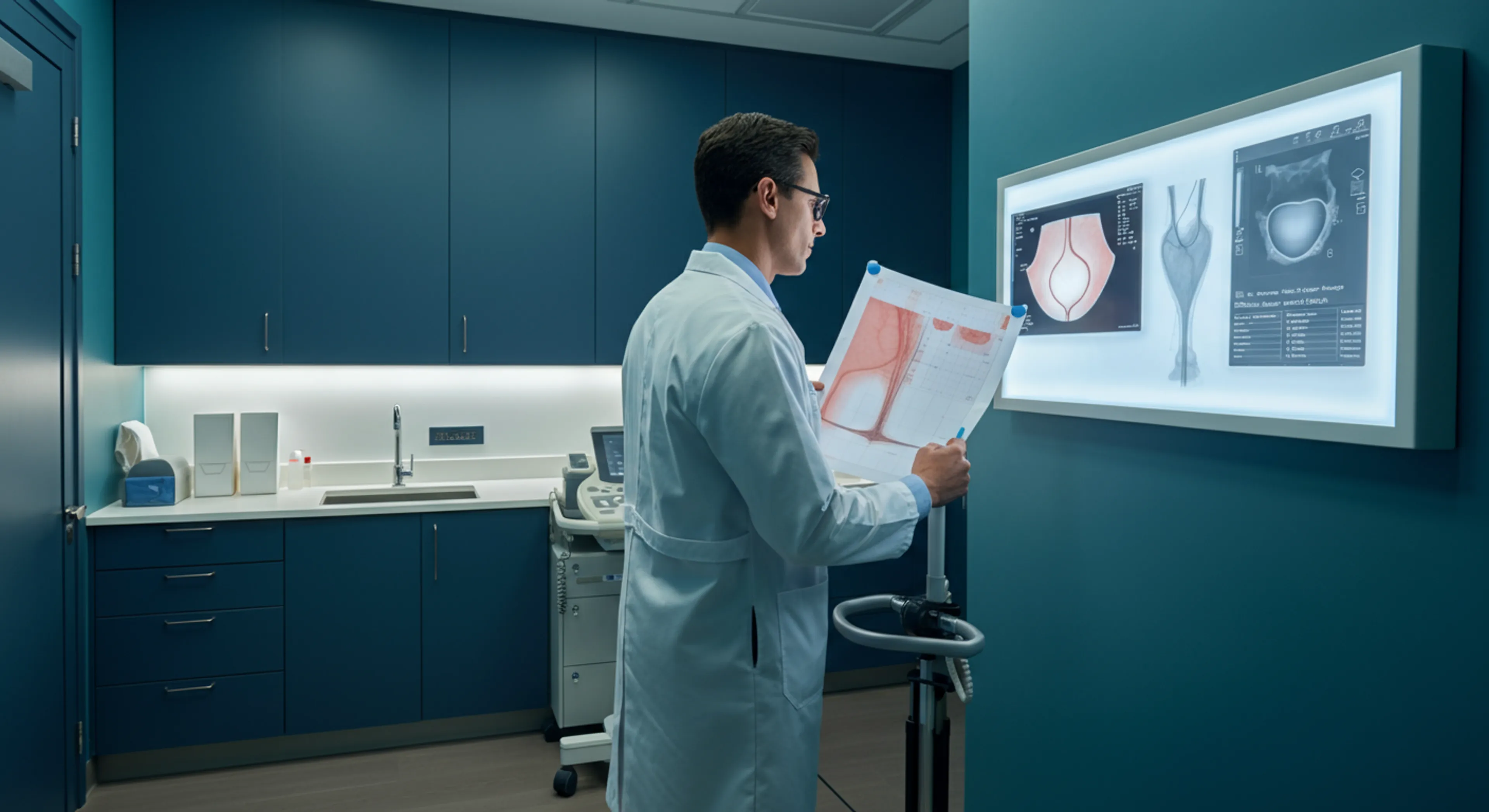
If urinary symptoms are starting to run your day — planning journeys around toilets, waking at night, or worrying about a weak stream — you’re not being “dramatic”. LUTS can quietly reshape sleep, confidence and social life.
The good news: LUTS are common, and there is a structured, evidence-based way to investigate them. The goal of diagnosis is to understand your pattern, find (or rule out) important causes, and then choose the least invasive options that genuinely match what’s going on.
Feeling overwhelmed by details? You don’t need to memorise this page. Use it to recognise what you’re experiencing and understand what usually happens next — step by step.
Contact us Ask about a LUTS diagnostic assessment
Seek urgent help if you cannot pass urine at all, you have fever/rigors with urinary symptoms, severe pain, new weakness/numbness in the legs, or visible blood in the urine with clots.
On this page
1. What LUTS are (in simple terms)
LUTS isn’t one diagnosis. It’s a label for symptoms related to how your bladder stores urine and how you empty it. A useful way to think about the system is “store at low pressure, empty efficiently on demand”. LUTS happen when the coordination between bladder muscle, outlet (sphincters/urethra), nerves and (in men) the prostate is disrupted.
LUTS can reflect benign issues (like bladder irritation, overactive bladder, enlarged prostate) but can also signal conditions that need assessment, such as infection, stones, significant obstruction, or — less commonly — cancer. Diagnosis is about getting clarity early, protecting bladder/kidney health, and reducing unnecessary treatments.
Population studies show LUTS are highly prevalent in both men and women and increase with age. The EpiLUTS study reported most adults experience at least one symptom at least “sometimes”.
At a glance
- LUTS describe symptoms — they are not the diagnosis.
- Your pattern helps narrow the cause (storage vs voiding vs after-weeing).
- Objective tests (diary/flow/PVR/urine tests ± cystoscopy/urodynamics) make treatment safer and more effective.
2. Symptom groups
- Frequency:
- passing urine more often than usual (daytime).
- Urgency:
- a sudden compelling need to pass urine that is hard to defer.
- Nocturia:
- waking from sleep to pass urine (quantified best with a bladder diary).
- Urge incontinence:
- leakage associated with urgency.
- Stress incontinence:
- leakage with cough/sneeze/exertion (more common in women, but can occur in men).
Overactive bladder (OAB) is a symptom syndrome characterised by urgency, usually with frequency and nocturia, with or without urgency incontinence, in the absence of infection or other obvious pathology.
- Weak stream / slow flow
- Hesitancy:
- delay before urine starts
- Straining:
- needing to push to void
- Intermittency:
- stop–start stream
These can be due to bladder outlet obstruction (e.g., benign prostatic enlargement in men, urethral stricture, bladder neck issues) or a weak bladder muscle (detrusor underactivity). Symptoms alone can’t reliably tell the difference — this is why objective testing matters.
- Post-void dribble:
- small leakage soon after finishing.
- Sensation of incomplete emptying:
- may or may not match actual residual urine.
Measuring post-void residual (PVR) with ultrasound helps confirm whether significant urine is being left behind.
3. Why causes differ by gender and life stage
Benign prostatic enlargement becomes more common with age and can contribute to voiding symptoms, but storage symptoms (like urgency) are also frequent. In younger men, prostatitis-like symptoms and urethral strictures need consideration.
Urgency and incontinence are common and may relate to pelvic floor changes (including childbirth), menopause-related tissue changes, and pelvic organ prolapse. Assessment and treatment follow established pathways for women.
LUTS in younger adults deserve careful evaluation rather than assumptions. Depending on the pattern, we may consider infection, inflammation, urethral narrowing, bladder neck dysfunction, functional/pelvic floor issues, or (less commonly) neurological causes.
Diagnostic principles are the same. The important difference is making sure your history (including any gender-affirming care, hormones or surgeries if relevant) is understood respectfully and used to tailor the examination and testing plan.
4. Common causes of LUTS
- Benign prostatic enlargement (men)
- Overactive bladder / detrusor overactivity
- Urinary tract infection
- Bladder stones
- Urethral stricture / scarring
- Bladder neck dysfunction
- Diabetes-related nerve changes
- Neurological conditions (e.g., multiple sclerosis, Parkinson’s disease, spinal problems)
- Sleep apnoea and fluid shift issues contributing to nocturia
- Constipation (mechanical and reflex effects)
- Diuretics (increase urine production)
- Some antidepressants, opioids, sedatives (can impair emptying)
- Caffeine/alcohol (irritant/diuretic effects)
- Evening fluid timing and high-salt late meals (nocturia)
5. The UK diagnostic pathway
We map what you feel, when it happens, and how much it affects life (work, sleep, exercise, intimacy). In men, the International Prostate Symptom Score (IPSS) is a standard way to quantify symptoms and track change over time.
Depending on your symptoms, this may include abdominal assessment, focused neurological screen, and (where appropriate) a prostate examination in men or a pelvic examination in women. The aim is to identify clues to obstruction, prolapse, neurological patterns, or pain syndromes.
- Urine dip and culture
- to check for infection and blood.
- Kidney function blood test
- if there are features suggesting impairment (e.g., recurrent infections, palpable bladder, stones).
- PSA discussion (men)
- where appropriate, guided by UK recommendations.
NICE guidance highlights that suspected cancer pathways should be followed when indicated (for example, visible haematuria or other red-flag features).
- Bladder diary
- (usually 3 days): timings, volumes, urgency/leaks, fluid intake — essential for nocturia and urgency patterns.
- Uroflowmetry
- : measures flow rate and curve shape.
- Post-void residual (PVR)
- : ultrasound to see what’s left after voiding.
- Flexible cystoscopy
- (camera test) to inspect urethra and bladder lining (e.g., to assess strictures, stones, bladder pathology).
- Urodynamics
- to measure pressures and distinguish obstruction from weak bladder muscle, particularly before invasive treatment or when symptoms and simple tests don’t align.
- Imaging
- (ultrasound/CT/MRI) based on findings and risk factors.
EAU guidance emphasises structured assessment and selecting tests according to context and suspected cause.
Next step: If you’d like a structured diagnostic plan (rather than trial-and-error treatment), get in touch.
6. FAQs
Waking once can happen, especially with late fluids. Regular nocturia (especially ≥2 times) often has identifiable contributors (nocturnal polyuria, OAB, sleep issues, obstruction) and is worth evaluating with a bladder diary.
No. In men, prostate-related obstruction is common, but urethral narrowing, bladder neck issues, and a weak bladder muscle can present similarly. Tests like flow rate and PVR help guide the next step.
Your description is the starting point. Tests provide objective information that helps confirm the cause and reduces the risk of the wrong treatment (for example, surgery for “obstruction” when the main issue is a weak bladder muscle).
7. References
- NICE guideline CG97:
- Lower urinary tract symptoms in men: management
- (last reviewed 19 Dec 2024).
- NICE guideline NG123:
- Urinary incontinence and pelvic organ prolapse in women: management
- .
- International Continence Society (ICS):
- ·
- ·
- EAU Guidelines:
- Management of Non-neurogenic Male LUTS
- (2024; 2025 reprint).
- Coyne KS et al. EpiLUTS prevalence study (BJU Int, 2009).
- Abrams P et al. ICS terminology standardisation (Neurourol Urodyn, 2002).
