At the end of the day, my priority is your health and well-being. Whether you're dealing with a complex urological issue or seeking advice on a sensitive matter, I am here to provide the expert care you need with the compassion and understanding you deserve.
Varicocele and Fertility
A man in his mid-thirties comes in holding an ultrasound report. He and his partner have been trying for a baby for two years. She has been through everything — cycle tracking, hormone tests, her tubes checked — and all of it came back normal. Only later did anyone think to check him. His semen analysis showed a low count. The scan found a varicocele. He looks at the report and says: “So it’s me, then.”
Relief and blame, in the same breath. Relief that there is finally an answer. Blame that the answer seems to be him.
If you have landed here, you may be somewhere in that same sentence. Perhaps you have just been told you have a varicocele and you are trying to work out what it means for your chances of becoming a father. Perhaps you are further along, weighing up whether to treat it. Either way, the question underneath is usually the same: is this why — and can it be fixed?
Here is the honest shape of the answer. A varicocele is one of the few causes of male fertility problems that can actually be corrected. That is genuinely good news, and it is worth holding on to. But correcting a varicocele is not a switch that turns pregnancy on. It improves the conditions; it does not guarantee the outcome. Anyone who promises you more than that is selling a certainty that does not exist.
What follows is how I think about varicoceles and fertility — when they matter, when they do not, what the evidence actually shows, and how I decide who I would treat and who I would leave alone. Some of it is more detail than you may want today. Take what is useful now; the rest will be here when you need it.
What a varicocele is — and why it can affect fertility
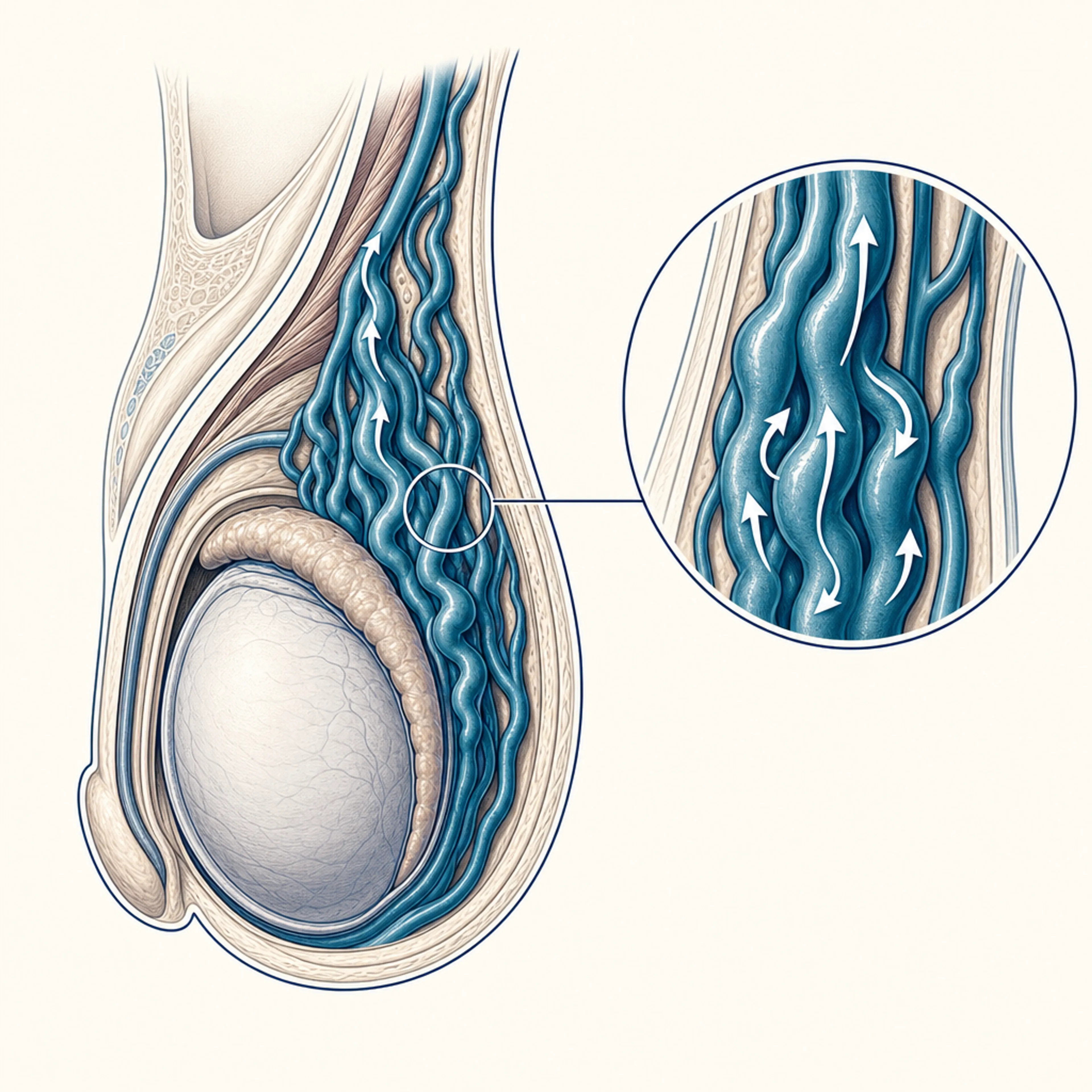
A varicocele is a collection of enlarged veins above and around the testicle, a bit like varicose veins in the leg. The valves that should keep blood moving in one direction stop working properly, so blood pools instead of draining away. On examination a larger one can feel like a soft “bag of worms” above the testicle.
The reason this matters for fertility comes down to one thing: heat and stagnation. Sperm production is exquisitely sensitive to temperature — it is the whole reason the testicles sit outside the body in the first place. When blood pools, it warms the testicle and creates what is called oxidative stress: a build-up of reactive molecules that damage developing sperm. Hold on to the phrase oxidative stress — it comes back later, because it is also the key to understanding a test that goes beyond the standard semen analysis.
Medical Evidence
American Urological Association / ASRM. Diagnosis and Treatment of Infertility in Men: AUA/ASRM Guideline (2024 amendment).
Source:AUANET.ORG
European Association of Urology. EAU Guidelines on Sexual and Reproductive Health (2025 edition).
Source:UROWEB.ORG
PIF TICK accredited information
The Patient Information Forum is the UK membership organisation and network for people working in health information and support. The PIF TICK is the UK-wide Quality Mark for Health Information.
Author Mr Giangiacomo Ollandini Published 15 June 2026Last update 15 June 2026Next review 15 June 2028Version v1.0
This content has been produced for educational purposes and reflects current evidence-based practice. Although GGO Med Ltd is a private urology service, all patient information is compiled with the aim of being accurate, evidence-based, and free from commercial bias. If you feel this content does not meet that standard, we would welcome your feedback — please contact us here.
On AI use: AI assists with literature scanning, readability and compliance checks, and prose drafting. Final clinical decisions and content sign-off remain with the consultant. How I use AI.
Having a varicocele does not mean you are infertile. Varicoceles are common, and most men who have one father children without ever needing treatment. The sections below are about working out whether yours is one that matters.
Does a varicocele cause infertility? The honest answer
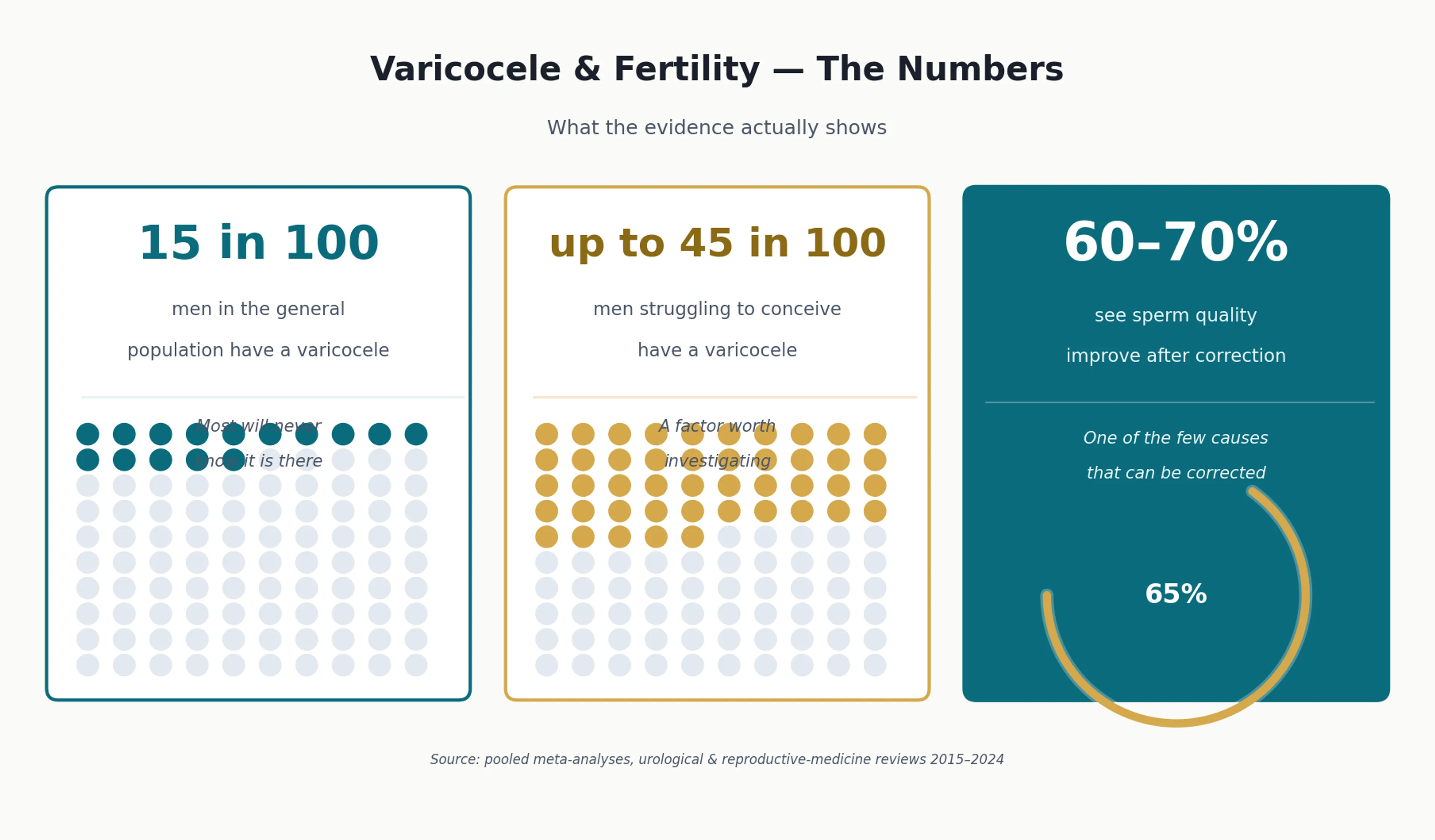
Here is the thing that surprises most men. Varicoceles are common — published estimates put them in somewhere between 10 and 20 of every 100 men. If a varicocele automatically meant infertility, that would be a staggering number of men unable to have children, and that is simply not the case. In fact the large majority of men with a varicocele are fertile. I will not give you a precise fraction for that, because the published figures vary a good deal and none of them is solid enough to quote as though it were. The direction, though, is not in doubt.
But turn the question around and the picture changes sharply. Among men who are struggling to conceive, a varicocele turns up far more often. In men who have never fathered a child it is found in roughly 35 to 40 in every 100; in men who have fathered a child before and are now struggling, the reported figures are higher still and much wider apart, from about 45 to 80 in every 100. And when a varicocele is genuinely part of the problem, correcting it tends to help the semen: across the published series, something in the order of 6 to 8 men in 10 show some improvement in their semen results afterwards. Read that carefully, though. It is a statement about semen results, not about babies — and those are not the same thing, which is a distinction I come back to further down this page.
So the honest answer to “does a varicocele cause infertility?” is: not on its own, and not in everyone — but in the right man, at the right grade, it can be a real and correctable factor.
Where do these numbers come from?
Varicoceles are found in roughly 35–44% of men with primary infertility (men who have never fathered a child) and in as many as 45–81% of men with secondary infertility (men who conceived before but are now struggling). Taken together, that puts the figure close to one in two, depending on the balance of the two groups in any given clinic. Some sources quote the combined figure more conservatively, at up to around 40%.
On treatment: pooled analyses of men with a clinical varicocele and at least one abnormal semen parameter consistently report that around 60–70% see measurable improvement in sperm quality after repair. These figures come from urological and reproductive-medicine reviews and meta-analyses published over the last decade.
How varicoceles are graded — the two scales, and why both matter
Not all varicoceles are equal, and the grade matters a great deal when deciding whether treatment makes sense. There are two different grading systems, and they measure two different things — which is exactly why confusing them causes so much needless worry. Let me set them out plainly.
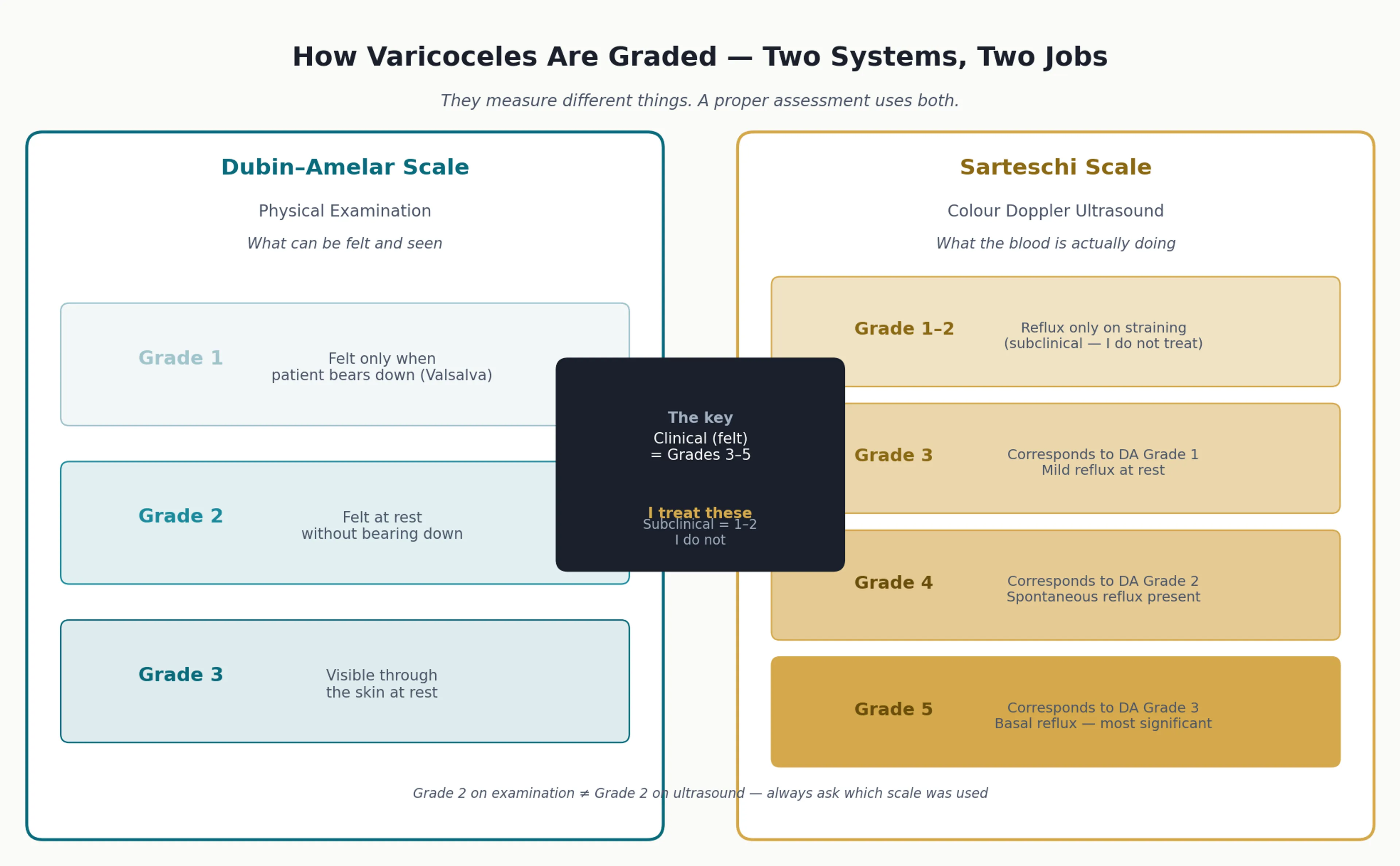
The first is the Dubin–Amelar scale, which grades by physical examination — what can be felt and seen. It runs from 1 to 3: grade 1 is felt only when you bear down, grade 2 is felt at rest, and grade 3 is visible through the skin.
The second is the Sarteschi scale, which grades by colour Doppler ultrasound — what the blood is actually doing. It runs from 1 to 5 and describes the pattern of venous reflux: from reflux seen only when you strain (grade 1), through to spontaneous reflux present at rest (grades 4 and 5). One scale tells you what can be felt; the other tells you what is happening to the flow. They are complementary, not rivals — and a proper assessment uses both.
The practical headline that cuts across both: the smallest varicoceles — those picked up only on ultrasound and not felt at all — are called subclinical, and I do not treat these for fertility. It is the ones that can be felt, and that show a meaningful reflux pattern on the scan, that may genuinely matter.
If you are holding a report that says “grade 2”, this is exactly why it is worth asking which scale was used — a grade 2 felt in clinic and a grade 2 on ultrasound are not describing the same thing.
The two systems map onto each other only loosely, because they measure different things. Broadly, the lowest Sarteschi ultrasound grades (1 and 2) represent subclinical disease that cannot be felt on examination at all, while Sarteschi grades 3, 4 and 5 correspond approximately to Dubin–Amelar clinical grades 1, 2 and 3. The higher Sarteschi grades (4 and 5) are defined by spontaneous reflux that is present at rest rather than only on straining — and these are the grades most often associated with changes in testicular size. This is the pattern of basal reflux that I have a particular research interest in, because how the blood behaves before treatment can help predict how much correcting it is likely to help.
The semen analysis — and why it is not the whole story
The first test in any fertility work-up is a semen analysis. It measures the things you would expect: how many sperm there are (concentration), how well they move (motility), and how normally they are shaped (morphology). For most men with a varicocele affecting fertility, this is where the problem shows up, and it is the main thing I look at when deciding whether to treat.
But here is the part that catches couples out: a semen analysis can come back entirely normal, and a couple can still be struggling to conceive. The standard test counts sperm and watches them swim — it does not look inside them. And sometimes the problem is inside.
But they told me my sperm was normal
Another man, also in his mid-thirties. His semen analysis was normal, so he could not understand why nothing was happening — “they told me everything’s normal,” he said, half-confused and half-angry at the whole process. The couple had been trying for a year and a half.
It was only when a different test — sperm DNA fragmentation — was measured that the picture changed. The result was high. And on scanning, there was a clinical varicocele. His standard analysis had been counting healthy-looking sperm without ever testing whether their genetic cargo was intact. That is the gap the next section is about.
Sperm DNA fragmentation: looking beyond the standard test
Sperm DNA fragmentation is a measure of how much breakage there is in the genetic material the sperm is carrying. A sperm can look normal and swim well, yet carry damaged DNA — and that damage can affect fertilisation, early embryo development, and the risk of miscarriage. This is where that earlier phrase comes back: the damage is largely driven by oxidative stress, the same mechanism a varicocele sets up.
This is the part of my practice that goes a little beyond the standard guidelines, so I want to be straight about where the evidence sits. In a man with a clinical varicocele and a normal conventional semen analysis but a high DNA fragmentation result, I think correction can be justified — because the varicocele is plausibly driving the fragmentation, and meta-analyses do show fragmentation improving after repair. But I would describe this as an emerging, evidence-informed position rather than a universal standard of care. A urologist who took a more conservative line here would not be wrong; the evidence is still maturing.
What is reasonably well established is that men with a varicocele have, on average, more DNA fragmentation than men without one — a recent pooled analysis of more than 4,000 men put the average difference at around 15 percentage points. What is not established is whether the grade of the varicocele tells you how high an individual man's fragmentation will be. The authors of that same analysis were clear that there were too few studies for them to compare fragmentation across grades at all. So this is genuinely an open question rather than a settled negative, and either way the practical conclusion is the same: you cannot read fragmentation off the size of the varicocele, so it has to be measured. That is precisely why, in the right couple, I measure it rather than assume.
On what repair does to fragmentation, the honest summary is this. Pooled studies show the fragmentation figure falling after varicocele repair — typically by around 6 or 7 percentage points by three months, with larger but much less consistent falls reported at six months and beyond. What no study has yet shown is that this fall, by itself, produces more pregnancies or more babies. It is a laboratory number moving in the right direction. That is a reason to be encouraged, not a reason to be promised anything.
The honest position
DNA fragmentation testing can reveal a problem the standard semen analysis misses — but treating on the basis of it is an emerging approach, not a settled one. I will always tell you which parts of a recommendation rest on firm ground and which rest on judgement.
When I would recommend treatment — and when I would not
This is the heart of it. A varicocele being present is not, by itself, a reason to treat it. What I am weighing is whether this varicocele, in this man, is likely to be holding back fertility in a way that correction can change. In practice, I would consider treatment in three situations:
Infertility with abnormal semen parameters and a clinical varicocele
(Sarteschi 3–5). This is the standard, well-evidenced indication.
Infertility with normal semen parameters but high DNA fragmentation
, again with a clinical varicocele. This is the emerging indication described above — offered after an honest conversation about what the evidence does and does not show.
Typical varicocele pain with a clinical varicocele.
Where the grade is low, I would usually start with pelvic floor physiotherapy before considering correction.
Just as important is when I would not treat. I do not treat subclinical varicoceles (Sarteschi 1–2) for fertility, and I would not rush to treat a varicocele found by chance in a man who is fertile and has no symptoms. Knowing when to leave something alone is as much a part of good urology as knowing when to act.
What the guidelines actually say
You may want to know whether what I have just described is my own view or the settled professional position. Mostly it is the settled position, and where it is not I have said so. It is worth seeing how the guideline bodies phrase it, because the wording carries information — and because one of them, the UK's own, changed its position in 2026.
The European Association of Urology gives its strongest form of recommendation to treating a varicocele that can be felt on examination, when the semen results are abnormal, the couple's infertility is otherwise unexplained, and the female partner's ovarian reserve is preserved. Note that last condition: the guideline itself builds your partner into the decision. It is not an afterthought.
The American joint guideline, from the AUA and the ASRM, reaches the same place but grades itself more cautiously: surgery should be considered for men with a palpable varicocele, infertility and abnormal semen results, and it labels this a moderate recommendation on grade B evidence. Both bodies are firm in the other direction, though — they advise against operating on a varicocele that can only be seen on the scan and never felt.
The UK guidance changed in 2026. The previous NICE guideline (CG156, 2013) carried a recommendation dating from 2004: men should not be offered surgery for varicoceles as a form of fertility treatment, because it does not improve pregnancy rates — a position that for years left this country out of step with both Europe and the United States. NG257, published on 31 March 2026, replaced it. Recommendation 1.28.1 now advises considering radiological or surgical treatment of a varicocele detected on clinical examination in people who are trying to conceive spontaneously and who have reduced semen parameters, taking female fertility factors into account. If you were told before 2026 that this operation was not offered here for fertility, that was accurate then and is not accurate now. Two things it does not mean. "Consider" is deliberately weaker than "offer" — it opens a discussion rather than settling it. And a change in national guidance is not the same thing as your local NHS service commissioning the procedure; that remains a separate question, and worth asking directly.
And on the DNA fragmentation indication I described earlier, the European guideline does now mention it — but rates it a weak recommendation. That is exactly the honest weight I would give it too, and it is why I would want to talk it through with you rather than simply offer it.
And there is a wider point I want to make here, because it gets lost so easily. A varicocele may be something happening in your body, but fertility is rarely a one-person story. The right decision is made by looking at the whole picture — your situation and your partner’s together. If, for example, time is tight for reasons on your partner’s side, then waiting several months to see whether your semen improves may not be the best use of that time, and it is worth discussing the options with a fertility specialist before deciding. None of that reduces the case for treating a varicocele that genuinely needs it — it simply means the decision belongs to the two of you, not to a test result in isolation.
What treatment involves: subinguinal microsurgery
When I correct a varicocele, I do it by subinguinal microsurgery — a small incision low down, below the level of the groin crease, through which the enlarged veins are tied off while the artery, the lymphatic channels and the vas are carefully preserved. It is done under general anaesthetic, as a day case, so you go home the same day.
Two pieces of equipment make the difference between a good result and a complication. The first is an operating microscope, which magnifies the cord enough to tell the tiny artery and lymphatics apart from the veins. The second is an intraoperative vascular Doppler, which lets me hear and confirm the artery so it can be protected rather than caught. This matters because the two things you most want to avoid — a build-up of fluid around the testicle (hydrocele) and the varicocele coming back — are both far less likely when the lymphatics and veins are properly identified.
The evidence backs this up. This is one of the better-evidenced parts of the whole picture. Pooling fourteen randomised trials, the Cochrane review found that the microsurgical subinguinal approach roughly halved the chance of the varicocele coming back compared with other surgical techniques, and the reviewers rated that finding moderate certainty — which is about as good as the evidence in this field gets. Reported recurrence after microsurgery sits in the low single figures and hydrocele is uncommon; the figures published for non-microsurgical techniques are both higher and far more scattered from one series to the next. The microscope and the Doppler are not luxuries; they are what makes the operation as low-risk as it is.
Earlier in my career, in Italy, I published on why some varicoceles respond better to correction than others — specifically, that the pattern of venous reflow seen on Doppler before treatment helps predict how much semen quality improves afterwards. That work used a different technique to the one I offer now (it studied retrograde sclerotisation, a radiological method, rather than microsurgery), so I would not present its specific numbers as outcomes of the microsurgery I perform today. What carries across is the underlying principle: the way blood behaves in a varicocele tells you something about whether correcting it will help — which is part of why I assess it carefully before recommending anything.
What to realistically expect afterwards
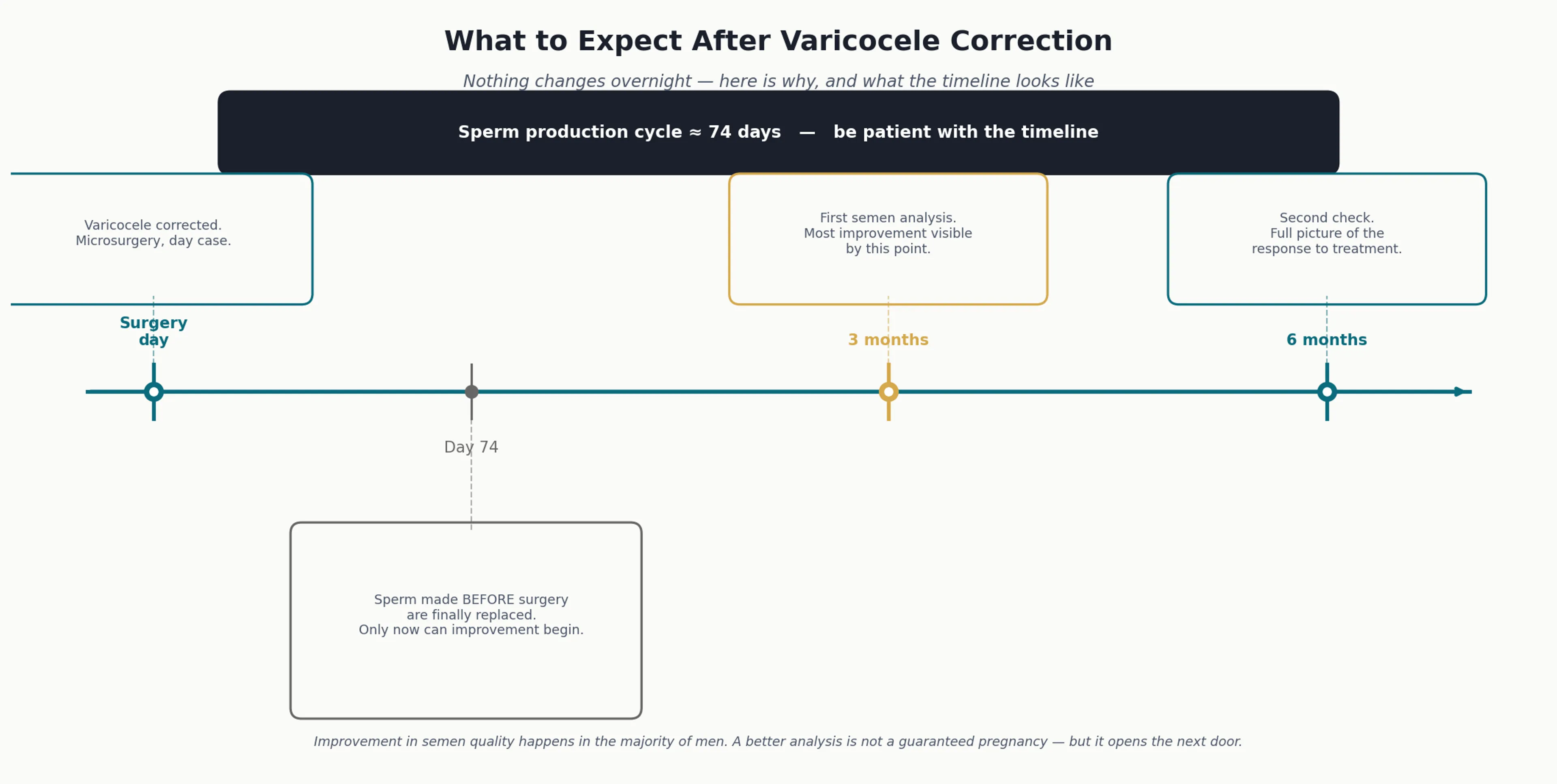
The single most important thing to understand is that nothing changes overnight. Sperm take around two and a half months to make — the full production cycle is roughly 74 days — which means the sperm in a sample taken just after surgery were made before anything was corrected. For that reason I check a semen analysis at around three months, and again at six. Most of the improvement that is going to happen tends to show by three months.
And now the honest framing, in more detail than most pages will give you, because you deserve to know how firm the ground is. Improvement in semen quality happens in a majority of men — that much is consistent across the studies. Pregnancy is a step further out. The Cochrane review, which pooled thirteen randomised trials and nearly 1,200 couples, found that treating a varicocele may improve the chance of pregnancy compared with waiting or doing nothing. But the reviewers rated that as low-certainty evidence, meaning further research could well change the estimate. And on live birth — a baby, which is what you actually came for — they found only two small trials, far too little to draw any conclusion at all. So: a better semen analysis is not the same as a pregnancy, and a likely improvement in pregnancy rates is not the same as a proven one. Treatment opens a door; it does not walk you through it, and I would rather tell you that now than have you hear it later.
This is also where the couple’s picture matters most. If after a few months the numbers have improved and conception follows naturally, wonderful. If they have not, that information is itself valuable — it lets you and your partner move on to other options, such as assisted conception, without having spent years wondering. Either way, you are making the next decision together, with better information than you had before.
The bottom line
A varicocele is common, and on its own it does not mean you cannot have children. But in a man who is struggling to conceive, with the right grade and the right findings, it can be a real factor — and one of the few that can actually be corrected. The decision to treat rests on the grade (I treat clinical varicoceles, not subclinical ones), on the semen analysis, and sometimes on DNA fragmentation when the standard test looks normal but something still is not right.
Most of all: a varicocele may be happening in your body, but fertility is something you and your partner face together. The best decisions get made looking at both of you, not at one test in isolation — and never under the weight of believing it is simply your fault.
Wondering whether your varicocele is one that matters?
I can assess the grade, review your semen analysis and, where it helps, look beyond it — and tell you honestly whether treatment is likely to help.
National Institute for Health and Care Excellence. Fertility problems: assessment and treatment. NICE guideline NG257, recommendation 1.28.1 (varicocele). Published 31 March 2026.
Source:NICE.ORG.UK
National Institute for Health and Care Excellence. Fertility problems: assessment and treatment. NICE clinical guideline CG156 (2013), superseded by NG257 on 31 March 2026 — the previous UK position advising against varicocele surgery as fertility treatment.
Source:NICE.ORG.UK
Liguori G, Ollandini G, et al. Role of renospermatic basal reflow and age on semen quality improvement after sclerotization of varicocele. Urology. 2010;75(5):1074-1078.
Source:PUBMED.NCBI.NLM.NIH.GOV
Cannarella R, et al. Effects of varicocele repair on sperm DNA fragmentation: a systematic review and meta-analysis. World J Mens Health. 2024;42(2):321-337.
Source:PUBMED.NCBI.NLM.NIH.GOV
Kavoussi PK, et al. Varicocele grade does not correlate with the degree of sperm DNA fragmentation or its improvement after repair. Transl Androl Urol. 2025;14(7):1904-1911.