


Here's something I see constantly in clinic, and it never stops surprising me.
Men arrive in two very distinct groups. The first group walk in certain they have a venous leak. They've read about it online, they've watched YouTube videos about it, and they may even have had a scan somewhere that "confirmed" it. The second group have never heard the term in their lives.
Here's the paradox: the men who are convinced they have a venous leak almost never do. And the men who actually have one may never have heard the term before.
Why? Because the first group typically fit the profile of someone experiencing high, sustained anxiety — and anxiety itself can produce something that looks exactly like a venous leak on a scan. They don't have a structural fault. They have a stress response doing exactly what stress responses do.
The second group tend to have a lifelong pattern of erection difficulty that has never been properly explained to them — and the term "venous leak" has never come up.
If you're reading this page, there's a fair chance you're in one of those two groups. Either way, I want to explain what's actually going on — clearly, honestly, and without the panic that the internet tends to generate around this topic.
Your penis is not a muscle
I know this might sound obvious, but it matters more than you think. Your penis is not a muscle. If it were, you could train it at the gym and it would get bigger — and I suspect the fitness industry would have noticed by now.
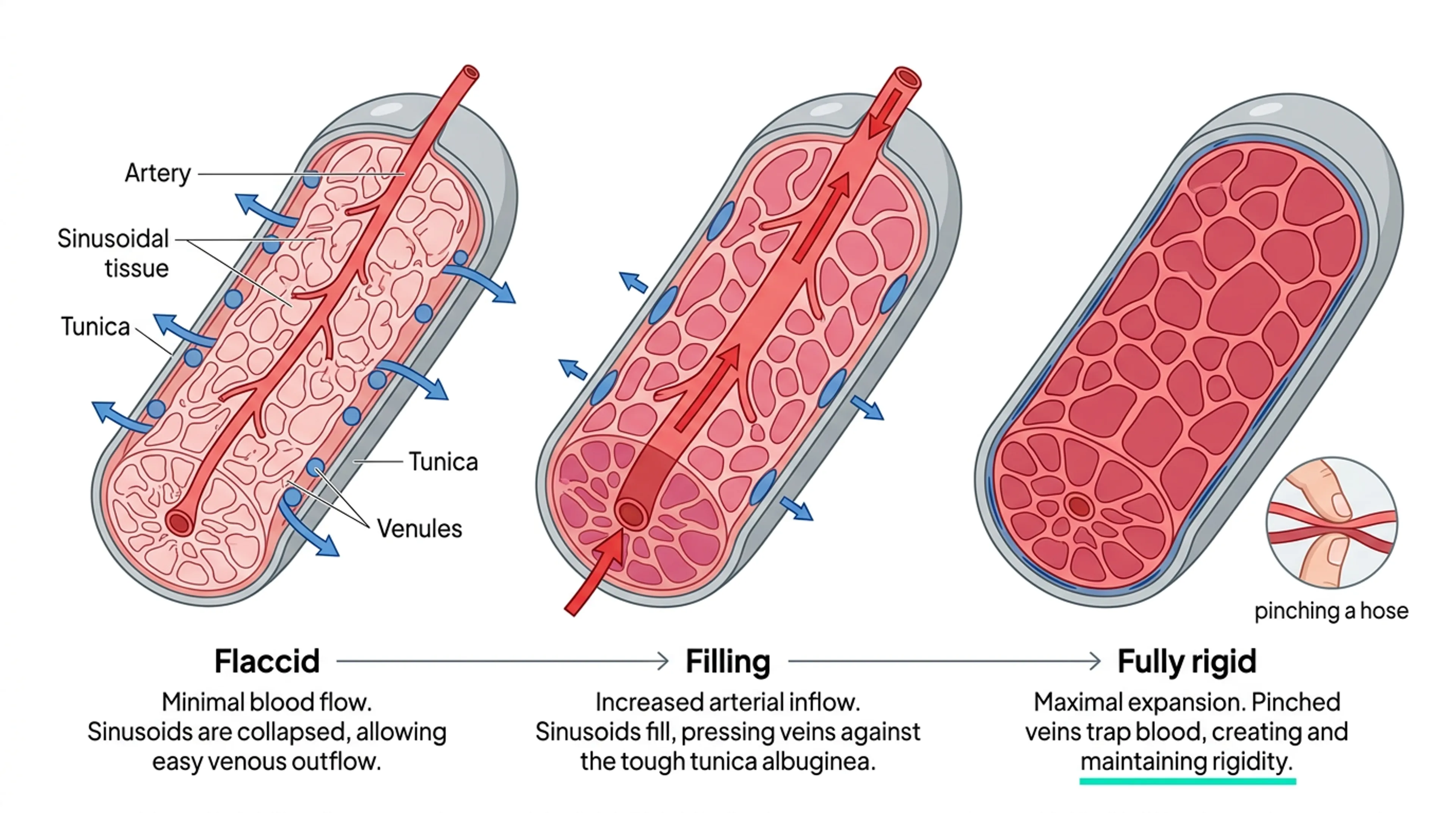
What the penis actually is: a complex bundle of blood vessels, wrapped in a thick, essentially inextensible layer called the tunica albuginea. Think of it as a highly engineered hydraulic system. When everything works properly, this structure traps blood inside itself at extremely high pressure — high enough to produce rigidity.
The two things that must happen
How an erection works
Blood floods in
Sexual arousal sends signals from the brain that relax the smooth muscle in the penile arteries. Blood rushes in — a massive increase in flow that fills the erectile chambers.
Blood gets trapped
As the chambers expand with blood, they compress the veins against the tunica — like pinching a hose shut. Blood can't leave. Pressure builds. Rigidity follows.
When both happen together, you get a rigid erection. When either one fails, you don't. This distinction — inflow versus outflow — is at the heart of everything on this page.
The gates — and the remote control
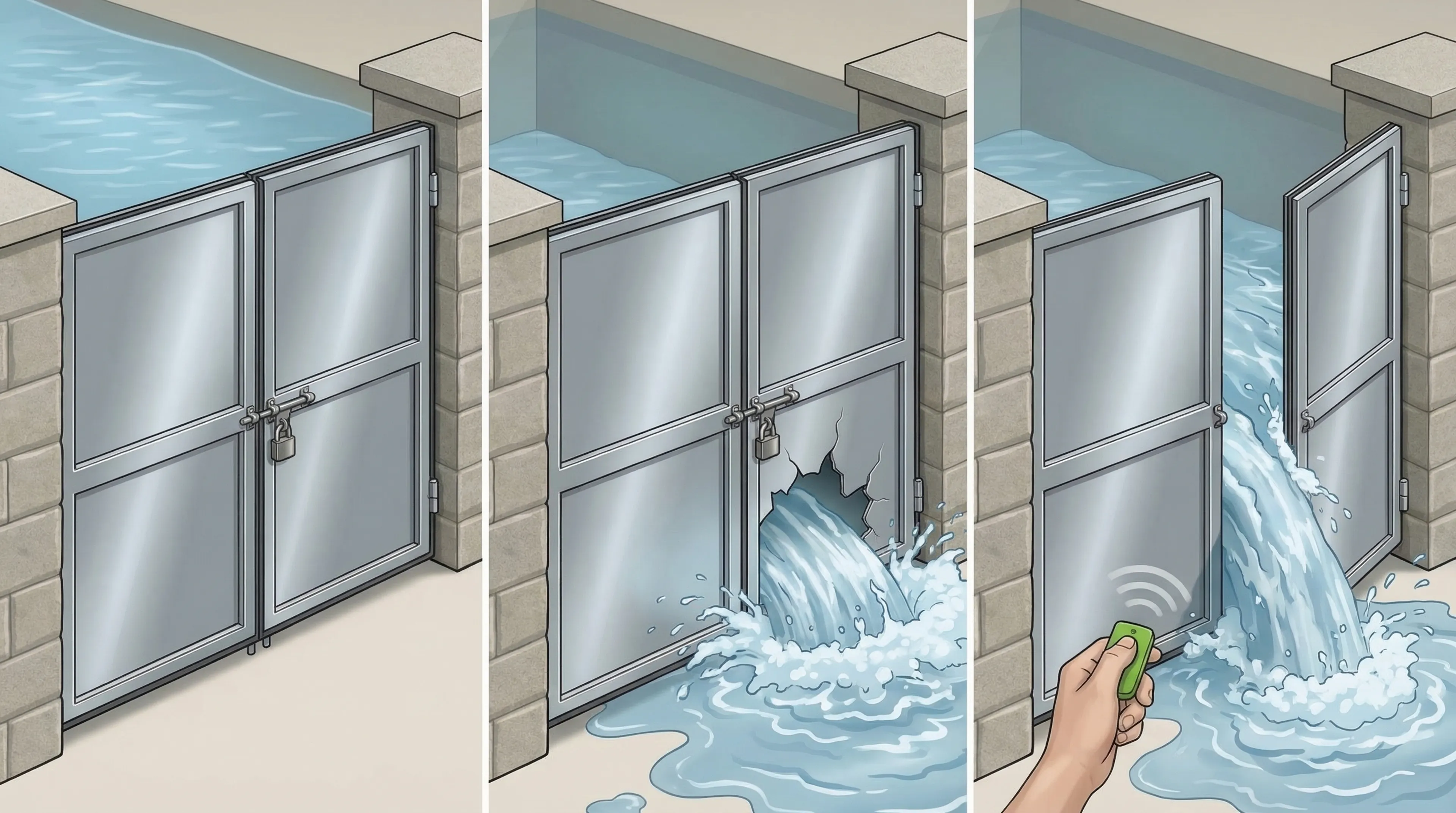
The structure that traps blood inside the penis has exit routes — think of them as gates. During an erection, these gates are forced shut by pressure. When the erection is meant to end, the gates open and blood drains away. That's normal.
A venous leak happens when those gates aren't fully watertight — blood leaks out when it shouldn't, and the erection either never reaches full rigidity or fades too quickly.
But here's where it gets complicated — and where many diagnoses go wrong.
There's something else that can force those gates open, and it has nothing to do with faulty plumbing. It's a remote control. It's called adrenaline.
You know the experience. You're a teenager, alone in your bedroom, and your mum knocks on the door — or worse, walks straight in. Or you're in an intimate moment with a partner and your boss rings and won't stop calling. The erection disappears instantly.
That's not a mechanical fault. That's adrenaline — and its companion noradrenaline — hitting a switch that forces the gates open and drains blood out of the penis. It's a biological override, and it's extremely powerful.
And here's the important part: it's not a mistake. Our bodies evolved over millennia in a world where a sudden threat meant one thing: run or fight. The last thing your ancestors needed when a sabre-toothed tiger appeared was to be sexually aroused. The body's rule is simple and absolute: fight or flight. Never, ever, seduce your enemy.
The problem is that our bodies haven't had time to adapt to the modern tigers — the ones that don't actually want to eat us, but trigger the exact same stress response. Performance pressure, work anxiety, relationship tension, health worries, the sheer terror of not getting hard when you desperately want to — they all hit the same switch.
Real venous leak versus the adrenaline impersonator
Venous leak: what's real and what isn't
Fact
Nearly half of venous leak diagnoses are wrong. Anxiety during the test activates adrenaline, which forces blood out — mimicking a leak that isn't structurally there.
A landmark study from Memorial Sloan Kettering re-tested 292 men who had been diagnosed elsewhere and chose to have the test repeated. 47% had completely normal blood flow.
Fact
True congenital venous leak is rare. In one study of 200 consecutive Doppler scans, only 6.8% of men under 40 had genuinely abnormal vascular findings. In another landmark study of 292 men who had their test repeated, 47% of those previously diagnosed with venous leak had completely normal blood flow — with younger men and men with few vascular risk factors the most likely to be misdiagnosed.
Fact
A real venous leak is a structural variant, not "damage." And even when confirmed, there are always treatment options — from tablets and injections to mechanical aids and, in severe cases, a prosthesis.
The patterns I see in clinic
Not every venous leak looks the same. Here's how the real thing typically presents — and how it's different from anxiety-driven erection difficulty.
What I see in my patients
Real venous leak: three presentations

Lifelong and constant
Young men who cannot remember ever having a fully rigid erection — not with a partner, not alone, not even during sleep. The pattern is the same across every context, every situation, every level of arousal. This is the textbook presentation of a congenital venous leak.

Progressive unmasking
Young men who notice a gradual worsening over months or years. When you're very young, the sheer surplus of blood flow — driven by peak testosterone — can compensate for a leaky mechanism. As that surplus naturally reduces with age, defects that were always there become exposed. The leak didn't appear — it was always there, hidden by the flood.
Acquired after injury or disease
Venous leak can develop after pelvic or perineal trauma — cycling injuries, straddle injuries, surgical damage. It can also be a consequence of plaque formation in Peyronie's disease, where the structural changes around the plaque disrupt the trapping mechanism.
Now compare that with the typical profile of the man who thinks he has a venous leak:
The anxiety impersonator
His erections work fine alone. They work in the morning. They fail with a partner — especially a new partner, or under pressure. Sometimes they start well and fade mid-way. The pattern is situational, not constant. This is the remote control, not the gates. His gates don't have holes — they're being forced open by a stress response he may not even be consciously aware of.
If the second description sounds more like you, I'd encourage you to read my page on erection difficulties with a partner before considering a Doppler — it may be more relevant to your situation.
What about the things you've read online?
I understand why certain concepts circulate so widely on forums and social media. They offer a mechanical explanation for something frightening — and a mechanical explanation feels fixable. But let me be straightforward about what the evidence actually shows.
"Death grip syndrome" is not a recognised medical diagnosis. It doesn't appear in any clinical guideline or diagnostic manual. The idea that masturbation technique damages penile tissue or causes venous leak has no support in the medical literature. What can happen is that a very specific stimulation pattern becomes a learned preference, making other forms of stimulation feel insufficient. That's a conditioning issue, not a structural one — and it doesn't require a scan.
"Hard flaccid" — a semi-rigid flaccid state with erection difficulty and sometimes numbness — first appeared in the medical literature only in 2021. The current evidence suggests it most likely represents a form of pelvic floor muscle overactivity, possibly with a neurovascular component, rather than a venous leak. If this describes your experience, a pelvic floor assessment is a more appropriate starting point than a Doppler.
Your experience of erection difficulty is real, but the explanation that pornography permanently destroys dopamine receptors is not supported by the best available longitudinal research. What the evidence does support is that performance anxiety, arousal conditioning, and the gap between screen-based and partnered arousal can all affect erection quality. These are treatable — through psychological support, behavioural change, and sometimes medication — and they are not venous leak.
Low-intensity shockwave therapy has shown modest evidence for improving blood flow in mild vasculogenic erectile dysfunction, but it does not repair a structural venous leak. The venous mechanism is an anatomical trapping system — shockwaves cannot close gates that have holes. A 2025 Cochrane review of 21 trials found only low-certainty evidence for benefit, and no guideline recommends shockwave for venous leak specifically. If a clinic is marketing this for your venous leak, ask them for the evidence.
Could it be something else entirely?
Before we move to diagnosis, two important possibilities to consider:
Your blood vessels — not a leak, but a decline
If your erections have been deteriorating gradually and you have cardiovascular risk factors — high blood pressure, high cholesterol, diabetes, smoking, family history of heart disease, or sedentary lifestyle — the problem is probably not a venous leak. It's more likely to be a progressive loss of vascular health.
This matters for two reasons. First, improving cardiovascular risk factors can genuinely improve your erections. Second — and this is something I feel strongly about — erection problems in a man with cardiovascular risk factors can be an early warning sign of heart disease. The arteries in the penis are 1–2mm wide; the coronary arteries are 3–4mm. Atherosclerosis clogs the smaller ones first.
Erectile Dysfunction and Cardiovascular Disease
If your erections are declining and you have risk factors for heart disease, this page explains why that connection matters — and what I check.
Your pelvic floor — tension, not leaking
The muscles of the pelvic floor play a role in the rigid phase of an erection. When these muscles are chronically tense — pelvic floor hypertonicity — they can interfere with the trapping mechanism, producing symptoms that mimic venous leak. This is more common than recognised, particularly in younger men with stress or chronic pain. Counterintuitively, standard Kegel exercises can make it worse — the issue is tension, not weakness.
If your erection problems come with pelvic pain, perineal discomfort, or urinary symptoms, a specialist pelvic floor physiotherapist may be a better starting point than a Doppler.
How I investigate: the Penile Doppler done properly
When the history and examination suggest a genuine possibility of venous leak — particularly in men with lifelong, context-independent erection difficulty — I offer a Penile Doppler ultrasound. But I approach this test very differently from how it's often done elsewhere.
Why the injection
A clinical room is perhaps the least erotic place on earth. So we use a medication called Alprostadil, injected directly into the erectile tissue, which produces an erection without needing arousal. This lets me assess your blood flow mechanics in a controlled way.
But — and this is critical — Alprostadil does not block the remote control. Adrenaline and noradrenaline can still do their work. Which means anxiety during the test can still force the gates open and make the scan show what looks like a venous leak when there isn't one.
This single fact explains why so many venous leak diagnoses don't hold up. In a landmark study at Memorial Sloan Kettering, 47% of 292 men who had been diagnosed with venous leak elsewhere had completely normal blood flow when the test was repeated with a fuller protocol, and the diagnosis was confirmed in only 43%. These were men who chose to have their test repeated at one specialist centre, so the figure describes that group, not every diagnosis. Three things were linked to a higher chance of a false diagnosis: being younger than 45, not getting a good-quality erection during the original scan, and having fewer than two vascular risk factors.
Why protocol matters
My two rules before diagnosing venous leak
Rule one: the flow threshold
I cannot say anything meaningful about the venous mechanism until arterial inflow is adequate — specifically, peak systolic velocity above 35 cm/s. Below that threshold, the main finding is arterial insufficiency and the venous system simply can't be assessed. Many clinics miss this and diagnose "venous leak" when the real issue is blood not getting in.
Rule two: the emotional state
I monitor the whole picture. If scan values suggest venous leak but the patient's heart rate is at 90–95, he's visibly tense, and the history doesn't fit a structural leak — I know the remote control may be responsible. The numbers on the screen are only half the story.
What I actually see on the screen
The second test: when I bring in the shield
When I suspect that anxiety is contaminating the result, I offer a second scan on a different day using a different medication mix that includes phentolamine.
Phentolamine is, in effect, a shield for the remote control. It blocks the action of adrenaline and noradrenaline on the erectile tissue. Even if the patient is tense, stressed, and anxious, the chemical override cannot reach the gates.
In many cases, what looked like a clear venous leak on the first scan disappears entirely on the second. The mechanism was always fine — it was being sabotaged by stress hormones.
This is why I never make a life-changing diagnosis on a single test. And it's why the protocol matters as much as the equipment.
INTERACTIVE REPORT: Venous leak vs Adrenergic Response
How specialists interpret a penile Doppler scan Explore a real report comparing anxiety-related response vs confirmed structural venous leak
Treatment — what we can actually do
I'm going to be completely honest, because you deserve honesty more than optimism.
There is no cure that eliminates a structural venous leak entirely. Attempts at venous surgery have been tried extensively, and the American Urological Association explicitly recommends against it — the long-term results are poor.
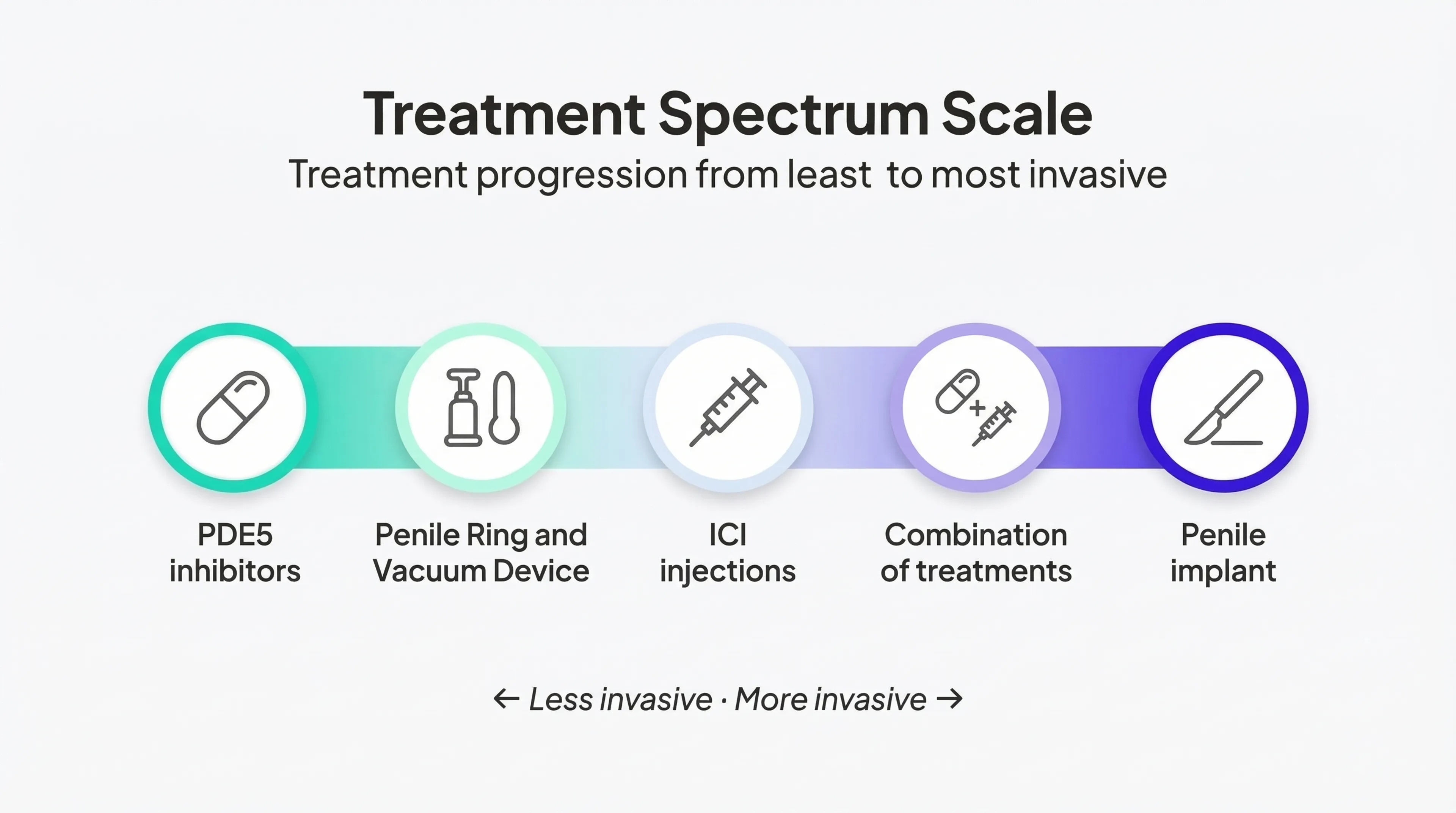
But here's what I also want you to hear: when it comes to erections, there is always a solution. Always. The question is not whether we can help, but how far along the spectrum of options you're comfortable going.
The hydraulic logic
If you can't close the leaks, the alternative is straightforward: flood the system. Push so much blood in that rigidity is maintained despite the drainage.
These enhance the blood flow signal. For some men with a mild venous leak, the extra inflow is enough to overcome the drainage and produce a usable erection. For others, they help but don't fully solve the problem. They're always worth trying first.
A small injection of medication directly into the erectile tissue, producing a strong erection by dramatically increasing blood flow. More powerful than tablets. Some men find this gives them enough rigidity even with a significant leak. One firm rule applies here too: if it stays hard for more than 4 hours, that's an emergency — go straight to your nearest A&E. Your first injection is always done with me in clinic, not at home, so you know what to expect before you do it yourself.
A ring placed snugly around the base of the penis and scrotum that mechanically traps blood inside — physically holding the gates shut from the outside. It needs to be fairly tight to work. One firm rule: never leave it on for more than 30 minutes.
A pump that draws blood into the penis by creating negative pressure, then a constriction band at the base holds it in — the same trapping principle as the ring, with the pump doing the initial filling work.
Some men discover that maintaining direct stimulation throughout the encounter keeps the erection going. Others find that certain positions work better than others. These aren't failures — they're practical adaptations that many couples integrate with complete naturalness.
Even when the venous leak is confirmed as organic, anxiety about the problem often makes it worse — adrenaline piling on top of a mechanical issue. A psychosexual therapist can help with coping strategies and relaxation techniques that prevent the stress response from compounding the leak.
Mix and match — finding YOUR combination
Here's something most clinics won't tell you: many of my patients end up with their own personal combination. Tablet plus ring. Injection plus a particular technique. The body isn't prescriptive about how you achieve a good erection, and neither am I. If a combination works for you and there are no dangerous interactions, that works for me too.
There is no single "correct" protocol. There's what works for you.
No universal recipe
Not every man with a venous leak experiences it the same way. Some are frustrated and depressed. Others manage the situation with remarkable naturalness — shorter encounters, different techniques, a focus on intimacy that goes well beyond penetration. Some are not "settling" — they are genuinely happy. There is no universal recipe because there are no universal people.
When the only realistic option is a penile prosthesis
Some cases of venous leak are severe enough that no amount of medication, injection, or mechanical assistance can produce a usable erection. Once the Doppler confirms good arterial inflow but significant, irreversible venous drainage — sometimes with the draining vein pulsing like an artery — a penile prosthesis becomes the most realistic path.
I won't pretend this is a small thing. It's an invasive surgical procedure with a real recovery period. It is also, in practical terms, a commitment to a prosthetic solution rather than a return to the natural erectile mechanism. But the evidence shows that satisfaction rates are high — the majority of men who have the procedure are glad they did. When it's the only alternative to never having a functional erection, it deserves to be considered with clarity and calm rather than fear. In cases where it's indicated, it resolves the problem definitively, and the decision should not be delayed unnecessarily.
What if surgery isn't for me?
Quick check — is venous leak really your issue?
Answer honestly — this isn't a diagnosis, but it can help you understand your pattern before you see me.
Find your next step
Which pattern sounds most like you?
Common questions about venous leak
A true structural venous leak does not typically heal on its own — the problem is in the physical integrity of the trapping mechanism. However, what many men experience as "venous leak" is actually an anxiety-driven response mimicking the same pattern on a scan. That absolutely can improve, sometimes dramatically, with the right support. Getting the diagnosis right is the first step.
Venous ligation surgery has been attempted extensively, but the long-term results are poor and the American Urological Association explicitly recommends against it. Treatment focuses on working with the leak — increasing inflow, mechanical trapping, or in severe cases, prosthetic replacement — rather than trying to repair it surgically.
It depends on the cause. A congenital leak may become more apparent as age-related blood flow reduction unmasks it. An acquired leak from trauma or Peyronie's may stabilise once the underlying condition is addressed. Maintaining good cardiovascular health always helps preserve function.
No. Low-intensity shockwave therapy has shown modest evidence for mild vasculogenic ED, but it cannot repair a structural venous leak. A 2025 Cochrane review found only low-certainty evidence for benefit in ED generally, and no guideline recommends it for venous leak. If a clinic is marketing shockwave for your venous leak, ask for the evidence.
Not a structural one — but if your symptoms are partly driven by pelvic floor hypertonicity (chronic muscle tension mimicking a leak), specialist physiotherapy targeting relaxation can help. Standard Kegels can make things worse if tension, not weakness, is the issue. Assessment before treatment.
The injection causes a brief sting lasting a few seconds. The ultrasound itself is completely painless. Overall discomfort is minimal, and I explain every step as we go.
I inject Alprostadil into the erectile tissue, then use ultrasound to measure blood flow in real time over a series of measurements. The process takes about 30–45 minutes. I explain what I'm seeing throughout. If a second test with phentolamine is needed, that's arranged for a separate visit.
Yes — especially if you're under 45, you were anxious during the test, or the diagnosis doesn't match your pattern (for example, if erections work fine alone). Nearly half of venous leak diagnoses don't hold up on repeat testing with a proper protocol. A second opinion isn't questioning your previous doctor — it's protecting you from an incorrect diagnosis.
No. It's not a recognised medical diagnosis and doesn't appear in any guideline. There's no evidence that masturbation technique causes structural damage. A learned stimulation preference can develop — but that's conditioning, not damage, and it doesn't need a scan.
Worried about a venous leak?
If you've been told you have a venous leak — or suspect one — I can give you a clear, honest diagnosis with a properly conducted Penile Doppler and a thorough clinical assessment.
Where this page sits in the bigger picture
Keep reading