-Provisional content; this page will soon be updated-
Understanding Haematuria – Your Complete Guide
Have you noticed blood in your urine? Whether it's a visible colour change or something detected on a routine test, this discovery can be genuinely alarming. You're not alone in feeling concerned, and that anxiety is completely understandable. This comprehensive guide will help you understand what haematuria means, why it happens, and what steps you should take next.
1.1 What Is Haematuria? – The Simple Explanation
Haematuria simply means the presence of blood in your urine. It's a sign—not a disease itself—much like a warning light on your car's dashboard. The light indicates something needs attention, but doesn't tell you exactly what the problem is.
Blood in your urine indicates bleeding somewhere along your urinary tract—the sophisticated system comprising your kidneys, ureters (the tubes connecting kidneys to the bladder), bladder, and urethra (the tube through which urine exits your body).
The good news? While discovering blood in your urine can be worrying, many causes are entirely treatable. What matters most is getting the right investigation promptly so we can identify the specific cause and ensure you receive appropriate care.
đź’ˇ Key Point: Finding blood in your urine is a signal that needs investigating, not ignoring. Most causes are benign and treatable, but thorough assessment is essential to exclude serious conditions.
Visible Haematuria (Macroscopic Haematuria)
This means you can see discolouration in your urine—it may appear pink, red, brown, or 'cola-coloured', sometimes with visible blood clots. Even a small amount of blood (as little as 1ml per litre of urine) can cause a visible colour change.
Clinical significance: Research from a systematic review published in European Urology (Rai et al., 2022) demonstrates that approximately 17% of patients presenting with visible haematuria are diagnosed with bladder cancer, with an additional 2% diagnosed with renal cell carcinoma. This doesn't mean you have cancer, but it explains why visible haematuria always warrants urgent investigation.
Microscopic Haematuria (Non-Visible Haematuria)
Here, the urine looks normal in colour to the naked eye, but red blood cells are detected when the urine is examined under a microscope or via a urine dipstick test. The standard definition is typically the presence of 3 or more red blood cells per high-power field (RBC/hpf) on microscopic analysis.
Clinical significance: According to the meta-analysis by Defined et al. (European Urology Focus, 2024), microscopic haematuria carries a cancer risk of approximately 3.3% (95% CI 2.45-4.3%). While lower than visible haematuria, this still warrants systematic investigation, particularly in individuals with risk factors.
Glomerular vs. Non-Glomerular Haematuria
Determining where the bleeding originates is crucial for diagnosis:
- Glomerularhaematuria originates from the kidney's filtering units (glomeruli), often indicating nephropathy. Clues include dysmorphic (abnormally shaped) red blood cells, RBC casts, and proteinuria. This requires nephrology investigation.
- Non-glomerular (urological)haematuria originates from anywhere in the urinary tract after the kidney filters. Clues include normally shaped red blood cells and absence of significant proteinuria. This is primarily investigated by urologists.
2: What Causes Blood in Urine?
2.1 Common Causes – The Simple Explanation
Haematuria can arise from many different conditions affecting any part of your urinary tract. Here are the most common causes we see in clinical practice:
Urinary Tract Infections (UTIs)
Bacterial infections of the bladder or kidneys can cause inflammation that leads to bleeding. UTIs are the most common cause of haematuria, particularly in women. They typically cause additional symptoms like burning when you pass urine, needing to go more frequently, and urgency.
Kidney and Bladder Stones
Mineral crystals can form into hard stones within your urinary system. As these stones move, they can scratch the lining of your urinary tract, causing bleeding. Kidney stones often cause intense pain in your side or back (renal colic), though some larger stones may cause painless haematuria.
Benign Prostatic Enlargement (BPH) – Men
The prostate gland naturally enlarges with age in most men. This enlarged tissue has increased blood supply and can bleed, causing haematuria. You might also notice symptoms like a weak urinary stream, difficulty starting, or needing to pass urine frequently, especially at night.
Urological Cancers
While this is naturally the concern that worries people most, it's important to understand the facts. Cancers of the bladder, kidneys, or ureters can all cause haematuria. Bladder cancer typically presents with painless visible haematuria. The risk increases significantly with age and smoking history. Early detection through proper investigation leads to better outcomes.
Kidney Diseases (Glomerulonephritis)
Conditions affecting the kidney's filtering units can allow blood cells to leak into your urine. These are often associated with other signs like protein in the urine and may require investigation by a kidney specialist (nephrologist).
Other Important Causes
- Prostatitis (prostate inflammation)
- Medications (particularly blood thinners)
- Strenuous exercise ('runner's bladder')
- Recent medical procedures
- Menstruation (contamination in women)
Pathophysiological Mechanisms
Understanding how these conditions cause bleeding helps appreciate why thorough investigation is necessary:
Infection/Inflammation: Bacterial invasion triggers an inflammatory cascade with neutrophilic infiltration, increased vascular permeability, and mucosal ulceration. Cytokines released during this process cause capillary dilation and microhaemorrhage from the bladder or kidney lining.
Urolithiasis: Physical abrasion of the urothelium by stone surfaces with irregular crystalline projections causes direct mucosal trauma. Ureteric stones additionally cause pressure necrosis from obstruction, and the inflammatory response to stone impaction further compromises mucosal integrity.
Benign Prostatic Hyperplasia: Age-related prostatic growth (driven by dihydrotestosterone-mediated epithelial and stromal proliferation) results in increased stromal vascularity. These dilated, fragile submucosal vessels are prone to rupture, particularly with straining during micturition or following instrumentation.
Urothelial Malignancy: Tumour angiogenesis creates structurally abnormal, fenestrated vessels lacking normal pericyte support. These fragile neovessels are prone to spontaneous haemorrhage. As tumours grow, mucosal ulceration and direct invasion of surrounding tissues contribute further to bleeding.
Glomerular Disease: Injury to the glomerular basement membrane (through immune complex deposition, complement activation, or direct antibody attack) compromises the filtration barrier. Red blood cells are forced through damaged capillary walls, becoming dysmorphic in the process—a pathognomonic finding on urine microscopy.
CHAPTER 3: Understanding Your Risk
3.1 Who Is Most at Risk? – The Simple Explanation
While anyone can develop haematuria, certain factors increase the likelihood that blood in your urine might indicate a serious underlying condition. Understanding your personal risk profile helps determine how urgently you should be investigated.
The main risk factors to consider include:
- Age: Risk increases significantly after age 40-50, with peak incidence in the 60s, 70s, and 80s
- Smoking history: Current or past smoking is a major risk factor for both bladder and kidney cancer
- Type ofhaematuria: Visible blood carries higher risk than microscopic haematuria
- Gender: Men have higher rates of bladder and kidney cancer
- Occupational exposure: Certain chemicals used in dye, rubber, and paint industries increase bladder cancer risk
- Previous pelvic radiotherapy: Can increase long-term bladder cancer risk
⚠️ Higher Risk Combination: If you are over 60, have a smoking history, AND have visible haematuria, you have a significantly elevated probability of underlying malignancy (approximately 30-40% in some studies). This combination mandates urgent, comprehensive investigation.
Lower risk individuals: If you're under 40, have never smoked, and have only microscopic haematuria without other symptoms, your risk of serious pathology is very low. However, investigation is still generally recommended to exclude other causes like stones or kidney disease.
Evidence-Based Risk Stratification
Modern guidelines, including the 2020/2025 American Urological Association (AUA) Microhematuria Guidelines, employ risk stratification to guide investigation:
Low-Risk Category:
- Age <50 years (women) or <40 years (men)
- Never smoked or <10 pack-year history
- 3-10 RBC/HPF on microscopy
- No other risk factors
→ Option to repeat urinalysis in 6 months rather than immediate investigation
Intermediate-Risk Category:
- Age 40-59 years
- 10-30 pack-year smoking history
- 11-25 RBC/HPF
→ Renal tract ultrasound and cystoscopy recommended
High-Risk Category:
- Age ≥60 years
- >30 pack-year smoking history
- >25 RBC/HPF
- Any history of visible haematuria
→ Cystoscopy AND CT urography required
UK NICE Guidelines (NG12):
In the UK, the National Institute for Health and Care Excellence recommends urgent 2-week wait referral for suspected bladder cancer if:
- Visible haematuria persists or recurs after successful UTI treatment
- Age ≥60 with unexplained non-visible haematuria AND dysuria or raised white cell count
CHAPTER 4: The Diagnostic Journey
4.1 How We Investigate – The Simple Explanation
When you come to see me with blood in your urine, we follow a systematic approach to identify the cause. This pathway is designed to be thorough yet efficient, ensuring we don't miss anything important while avoiding unnecessary tests.
Step 1: Your Initial Consultation
We start by having a detailed conversation about your symptoms, medical history, and any risk factors. This helps me understand your individual situation and guides which tests will be most appropriate for you. I'll ask about:
- When you first noticed blood and whether it's visible or detected on tests
- Any associated symptoms like pain, urinary frequency, or fever
- Your smoking history and any occupational exposures
- Current medications, particularly blood thinners
- Family history of urological conditions
Step 2: Urine Tests
A simple urine sample provides valuable information:
- Dipstick test: Quick screen for blood, infection, and protein
- Microscopy: Confirms red blood cells and helps identify their source
- Culture: Checks for bacterial infection
- Cytology: Examines cells for abnormalities (sometimes requested)
Step 3: Blood Tests
Blood tests help assess your overall health and kidney function:
- Kidney function tests (U&Es, creatinine, eGFR): Essential baseline assessment
- Full blood count: Checks for anaemia and signs of infection
- PSA (for men): Prostate-specific antigen after appropriate discussion
Step 4: Imaging
Scans allow us to visualise your entire urinary tract:
- Ultrasound: Non-invasive first-line test for kidneys and bladder
- CTUrogram: Gold-standard detailed imaging for higher-risk cases
Step 5: Cystoscopy
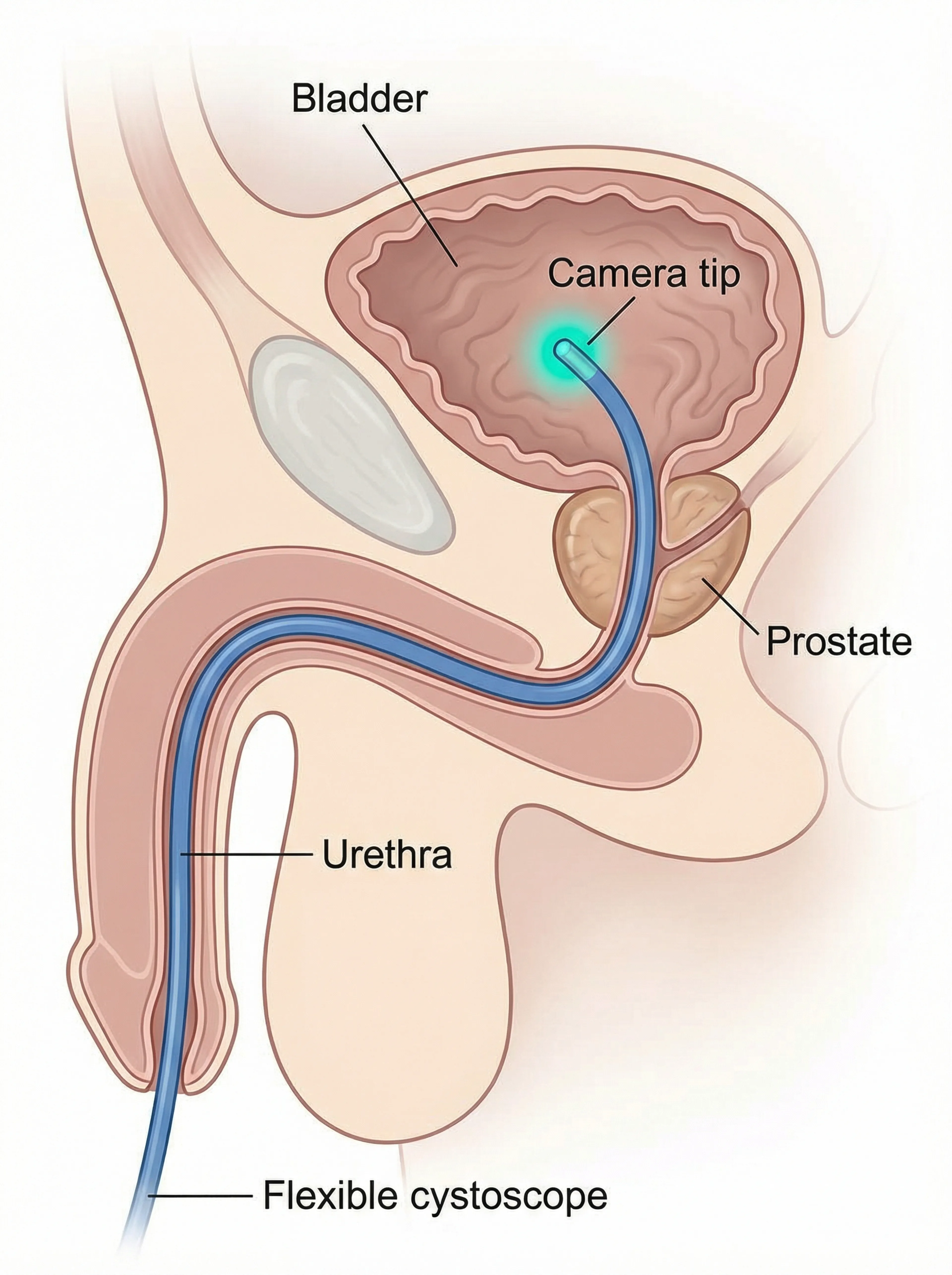
A camera examination allows direct visualisation of your bladder lining—the most accurate way to detect bladder abnormalities. This is typically performed as a simple outpatient procedure under local anaesthetic (flexible cystoscopy).
CT Urography (CT IVU)
Considered the gold-standard imaging for haematuria investigation. It involves X-rays with intravenous contrast dye to provide detailed multi-phase images:
- Non-contrast phase: Detects stones (which appear bright white)
- Nephrogenic phase: Images during kidney tissue enhancement (optimal for renal masses)
- Excretory phase: Images when contrast fills the collecting system (optimal for UTUC)
Sensitivity: Published data indicates CT urography has superior sensitivity for upper tract urothelial carcinoma compared to ultrasound (pooled sensitivity approximately 96% vs. 82%). However, the EBI 2024 guidance notes that CT urography carries a high dose of ionising radiation and the incidence of UTUC in non-visible haematuria is extremely low (0.4%), making ultrasound appropriate as first-line imaging for many patients.
Flexible Cystoscopy
A thin, flexible camera (approximately 5mm diameter) is passed through the urethra under local anaesthetic gel. The entire bladder lining is systematically inspected. According to the European Urology 2024 systematic review by Devlies et al., cystoscopy remains the current standard for detecting bladder cancer, with very high diagnostic accuracy exceeding other imaging modalities.
Whatwe're looking for: Tumours (papillary or flat lesions), carcinoma in situ (red patches), stones, inflammation, diverticula, and trabeculation suggesting bladder outlet obstruction.
Enhanced Cystoscopy Techniques
- Blue Light Cystoscopy (PDD): Uses photosensitising agent to make tumours fluoresce, improving detection of flat lesions and CIS
- Narrow Band Imaging (NBI): Enhances mucosal and vascular pattern visualisation without the need for instillation agents
CHAPTER 5: Cystoscopy – What to Expect
5.1 Your Cystoscopy Explained – The Simple Version
Cystoscopy is a camera test that allows me to look directly inside your bladder. I understand this can feel daunting, so let me explain exactly what happens:
Before the procedure:
- You'll be asked to provide a urine sample to check for infection
- You don't need to fast or have any special preparation
- Continue taking your regular medications unless specifically advised otherwise
During the procedure:
- You'll lie comfortably on your back
- A local anaesthetic gel is applied to numb the area
- A thin, flexible camera is gently passed through your urethra into the bladder
- Sterile water fills the bladder to allow a clear view
- The entire procedure typically takes 5-10 minutes
What does it feel like?
Most patients describe a sensation of pressure and an urge to pass urine rather than pain. The local anaesthetic gel makes the procedure much more comfortable. Taking slow, deep breaths helps you relax.
After the procedure:
- You can go home straight away and resume normal activities
- Drink plenty of fluids for 24-48 hours
- Mild burning when passing urine is normal for a day or two
- A small amount of blood in your urine is common and settles quickly
âś“ Reassurance: Flexible cystoscopy is one of the most commonly performed urological procedures. Serious complications are rare (infection risk 1-3%). Most patients find the procedure much more tolerable than they anticipated.